Category Archives: Self Publishing

Darker Places, Shaun Allan

My Writing LifeOne of my favorite people is Shaun Allan, author of the bestselling novel, Sin–he  can write circles around me. Actually, he can write circles around ANYone.  Shaun has a new book out today, Darker Places. I was fortunate to be asked to edit this book, and I’m just going to say, very little effort on my part is ever required with Shaun’s work.

Darker Places is a dark, literary fantasy, comprised of thirteen poems and 13 short-stories, in the same vein as Dark Places,  his book of short works that was published in 2012.

Shaun has consented to answer a few questions about his writing life for us:

CJJ: Tell us a little of early life and how you began writing:

SA: Early life…  Can I remember that far back?  I’m not sure I can…  I can’t think of a time when I haven’t been writing.  I’m told (by my mother who also tells me I was a little terror as a young child, which I can’t quite believe) I used to write stories and draw the pictures to go along with them.  Nowadays, my artistic skills are probably somewhat lacking.  I’m hoping my writing skills have improved, though.  At school, English was easily my favourite lesson and I loved writing the essays.  I was a big fan of science fiction, back then (I still am a fan, of course), so read lots of Arthur C. Clarke and Isaac Asimov amongst others.  I moved on to fantasy, with David Eddings and Terry Brooks and then brought in horror.  All these found their way into my writing, with horror and the supernatural becoming the mainstay of my subject matter now.  I feel, without the darkness, you can’t appreciate the light.

CJJ: Those are books I loved too. Tell us about your most recent book.

SA: Darker Places, my new book, is the follow up to Dark Places.  It’s an anthology of 13 stories and 13 poems which walk the reader through the shadowy passages of my mind. There’s ome humour in there (with Gremlins and Little Dead Riding Hood), some touching stories (The Crow and Stolen Moments) and much darker ones (Home) where I kill off a number of my old school friends, with their permission!  And, we get to see what happened with Sin before the events of his novel.

CJJ: I have to say that is an awesome story–Sin is an amazing character. And Home is one of the best, short stories I have read in a long time. Now we come to the question people always want to know:  How did you come to write this novel?
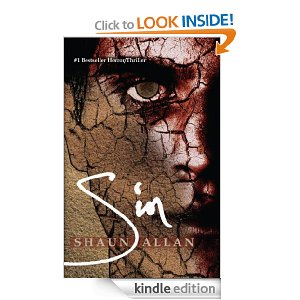
sin - Shaun AllanSA: Sin took me ten years to write.  As it’s a very personal book, I occasionally had to step away and wrote short stories.  Many of these were collected together in Dark Places, which was prompted by a comment a writer friend of mine made.  As my mind tends to write what it wants rather than what I want, and another friend, who lives in Australia, was very forthcoming with writing prompts I couldn’t refuse, Darker Places became more and more a reality.  I mean, if you’re given a starter sentence of “The bird fell and the sky was silent,” how can you not work with it?

CJJ: Do you have a specific ‘Creative Process’ that you follow, such as outlining or do you ‘wing it’?

SA: Oh, I wing it.  I know wonderful writers (Connie) who outline, but I can’t.  I’ve tried, but my mind doesn’t work like that.  It goes where it wishes, my Muse being a right royal pain in the posterior.  I sat down to write some of Mortal Sin and ended up writing a Christmas story about Rudolph, for example!  Sometimes, as with Mr. Composure, I can write the start and almost immediately know how it will end, with ‘only’ the path it takes to figure out, but often, I start and I have no idea at all.

CJJ: How does your work differ from others of its genre?

SA: I think because it’s personal.  There’s aspects of me, my life and my darkness in everything.  There’s also my sense of humour.  I set the stories where I live.  When I was starting, and everyone was saying “write what you know,” I struggled somewhat.  What did I know?  Where I lived seemed boring, for a start!  But then I read a Clive Barker book (Weaveworld, I think) and he described going down back alleys in a town.  I didn’t know, but felt it could have been the alleys where he grew up.  It wasn’t boring.  So I moved my stories to Grimsby and Lincolnshire – the places I knew.  Once they came home, they allowed me more freedom.

CJJ: Your work is dark, but you are such a cheerful, light-hearted person. Why do you write what you do?

SA: Good question.  Though I can write silly children’s poetry as well as paranormal and psychological thrillers, it’s the darker work which I find easiest.  I find it therapeautic.  I can get stresses and bad memories out and turn them into something I and others seem to enjoy.  As I say, without darkness, you can’t appreciate the light.

CJJ: I know why I chose the indie route for my work, but I’m curious as to why you’ve chosen this path.

SA: I did try to be ‘properly’ published, but, with the indie route, I’ve made some amazing friends and reached people all over the world.  I have full control over my work and the only deadline (in most cases) is the one I set myself.

CJJ: What advice would you offer an author trying to decide whether to go indie or take the traditional path?

SA: Well, you have to go for what you feel is right, but I have to admit, though the indie route is hard work, its immensely rewarding.  I’d definitely recommend giving it a go.

~~~~~~

Thank you Shaun, for taking the time to answer these questions, and for being here today!
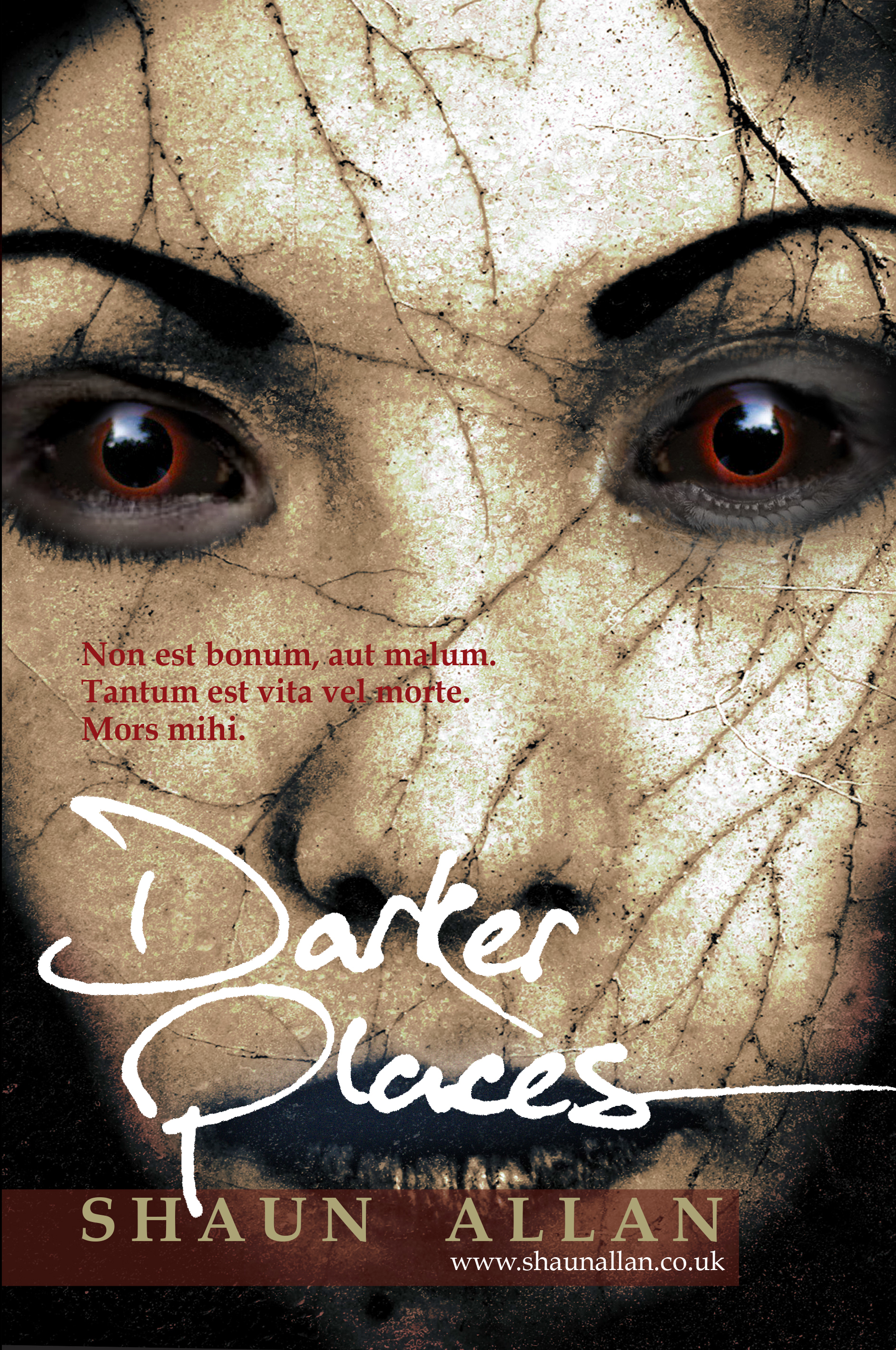
DarkerPlaces_96dpi_100%DARKER PLACES by Shaun Allan

What if you could steal the final moments from the dying? What if you had the darkest secret, but couldn’t think what it might be? What if you entered the forest in the deep of the night. Who is the melting man? And are your neighbours really whom they appear to be?

So many questions.

To find the answers, you must enter a darker place. Thirteen stories. Thirteen poems. Thirteen more doorways.

 ~~~~~

 

Shaun AllanA creator of many prize winning short stories and poems, Shaun Allan has written for more years than he would perhaps care to remember. Having once run an online poetry and prose magazine, he has appeared on Sky television to debate, against a major literary agent, the pros and cons of internet publishing as opposed to the more traditional method. Many of his personal experiences and memories are woven into the point of view and sense of humour of Sin, the main character in his best-selling novel of the same name, although he can’t, at this point, teleport.

A writer of multiple genres, including horror, humour and children’s fiction, Shaun goes where the Muse takes him – even if that is kicking and screaming. He has written for NBC Universal, and regularly holds writing workshops at local schools.

Shaun lives with his wife, two daughters and two cats. Oh and a manic dog. Though his life might, at times, seem crazy, he is not.

Honest.

~~~~~~

To see more of Shaun’s work, please visit Shaun’s author page at Amazon.com.
1 Comment

Filed under Adventure, Blogger, Books, Fantasy, Humor, Literature, Publishing, Self Publishing, Uncategorized, writer, writing

What I #amwriting

Alarm clock quote ray bradburyI normally begin my day at about 5:30 a.m. with editing for my clients–I like to do that when I am at my sharpest which is always in the morning.  I spend the afternoons writing, and right now I have two manuscripts that I am working on, and several short-stories. My evenings I either write blog posts or work on designing book covers.

Other than writing, most of my work these days centers around finishing up publishing the second editions of the Tower of Bones Series. The book itself, Tower of Bones, has been republished, and book II in the series, Forbidden Road, is in the process of being proofed and should be available soon–hopefully within two weeks.

In addition to revamping the TOB series, I hope to have the prequel to the series, a stand-alone novel, Mountains of the Moon, published by July 15, 2015, with a few copies to take to the PNWA conference. That means it has to be finished and ready to proof by June 25–which may be pushing it. However, things are moving so perhaps I will be able to meet this new deadline.

As I said, I have two novels in the works: concurrently with The Wayward Son, I am fleshing out the final book of the Tower of Bones series, Valley of Sorrows. This book deals with the aftermath of the events in Forbidden Road and winds up that story.

The road to hell Phillip Roth QuoteIn the aftermath of an incident that occurred in the last days of the war in Mal Evol, John lost the use of most of his magic. He has managed to keep that disability a secret for thirty years. The Wayward Son is the story of John’s redemption, and explains the events that happened in Aeoven while Edwin and the others were gone. These incidents culminated in John and Garran being sent to meet Edwin in Braden at the end of Forbidden Road. 

John Farmer’s story is intriguing to me, because he is a man concealing many secrets. A lot is going on under the surface–he suffers from survivor’s guilt and PTSD, which often develops after a person is exposed to one or more traumatic events. In The Wayward Son, John’s rocky relationship with Garran is explored, and also his love affair with the Abbess of Aeoven, Halee.

While I was re-editing the series to date, I took the liberty of changing several once-minor characters’ names, as they had suddenly become important in the two later books, and their names were too close to other, already prominent, characters’ names. Since I was changing them anyway, I made them widely different. Thus Marta Randsdottir is now Halee Randsdottir. Her original name was nearly identical to Edwin’s wife, Marya, a problem since the two women figure prominently in The Wayward Son.

The problem was inadvertently begun in 2009 when I was writing Tower of Bones as the story-line and walk-through for an RPG, and was scrounging around for good character names. I didn’t know at that time it would become a book, and it didn’t occur to me that NEVER naming any character with a similar sounding, looking, or rhyming name is something every author should take note of. This is important, no matter how minor the characters seem to be, because, just like Halee, they may have a larger part to play later and the confusion will ruin the story.

The magnitude of the problem first became evident when I was writing Forbidden Road, but I thought I was stuck with it. Referencing the two women in the same paragraph was dreadfully confusing, since their names were only one letter off from each other.

ok to write garbage quote c j cherryhFor a long time, I didn’t know what to do about the name problem. I thought I was stuck with it, but one of the beauties of being an indie is the freedom I have to make adjustments when a gross error is discovered. Since I was completely revamping the series anyway, it was the perfect time to take the plunge and rectify that mistake. The series now has new maps, new interiors, and new covers.

It was just another lesson I’ve learned since leaping into this mad circus of indie publishing, but now I know to never name two characters in the same book with names that begin and end with the same letters. Don’t do it!


Comments Off on What I #amwriting

Filed under Adventure, Battles, Books, Fantasy, Humor, Literature, Publishing, Self Publishing, Uncategorized, writer, writing

The Gormenghast Novels

Gormenghast trilogyOne of the strangest, most compelling series of books I ever read was the literary, yet still fantastic, Gormenghast series of novels, written by the late Mervyn Peake during the years following WWII.

It has been said of this series that it is the the first true fantasy of manners.

Satirizing the manners and affectations of a social class or of multiple classes, often represented by stereotypical stock characters, a “Fantasy of manners” is fantasy literature that owes as much or more to the comedy of manners as it does to the traditional heroic fantasy of J. R. R. Tolkien and other authors of high fantasy.

The Washington Post Book World had this to say about the series:  “This extravagant epic about a labyrinthine castle populated with conniving Dickensian grotesques is the true fantasy classic of our time.” 

The immense,  labyrinthine Hayholt, featured in Tad Williams’ epic masterpiece, Memory, Sorrow, and Thorn,  seemed reminiscent of castle Gormenghast to a certain extent, when I first read that series. I don’t know if Williams is a Gormenghast fan–I’ve never asked him, although I should. I do know he is not afraid to write great literary fantasy.

The Gormenghast series opens with the book, Titus Groan. Although the book takes its name from Titus, and he  is technically the main character, the book only covers the first two years of his life. Titus-the-baby appears infrequently throughout, but is still an integral part of the plot, inciting change in the routine of the immense castle. At the age of one, he becomes the Earl of Groan. The great library has been deliberately burned, sending the old earl, his father, spiraling into madness. He vanishes, having been eaten by Death Owls (!) while attempting to hide the body of his murdered chef, Swelter, who was murdered by another of his servants.

225px-Titus Groan novel

Mark Robertson’s cover illustration for the Mandarin paperback edition

Wikipedia gives this as the plot introduction for the series: “The book is set in the huge castle of Gormenghast, a vast landscape of crumbling towers and ivy-filled quadrangles that has for centuries been the hereditary residence of the Groan family and with them a legion of servants.

“The Groan family is headed by Lord Sepulchrave, the seventy-sixth Earl of Groan. He is a melancholy man who feels shackled by his duties as Earl, although he never questions them. His only escape is reading in his library. His wife is the Countess Gertrude. A large-framed woman with dark red hair, she pays no attention to her family or the rest of Gormenghast. Instead, she spends her time locked away in her bedroom, in the company of a legion of cats and birds, the only things toward which she shows affection.”

GORMENGHAST-72dpiThese complicated, convoluted books of nonsense are not for everyone. They are beautifully written, but the less perceptive, more impatient type of reader will find this series confusing and plot-less. Despite being a dark, Gothic fantasy, the prose is literary. For some casual readers, this work will be considered too heavy on the descriptions  It may also contain too many “ten-dollar” English words–words of more than one syllable.

But for those readers like me, readers who adore beautiful prose, deep, involving  books, and darkly baroque settings peopled with unforgettable characters, the Gormenghast Novels strike a chord deep within the soul. These books must be savored, experienced in the fullest sense of the word. The focus is on the breathtaking visual descriptions, and while I am thrilled by it, the verbal beauty of Gormenghast is what will leave many impatient modern readers cold.

For me, Gormenghast is a surreal, visual painting, created of beautifully crafted words., and frankly, I say to hell with anyone who mocks my enjoyment of it.

Mark Robertson's cover illustration for the Mandarin paperback edition

Mark Robertson’s cover illustration for the Mandarin paperback edition

Just like J.R.R. Tolkien’s work, when you are reading this series of novels, the journey itself is more important than the destination. And speaking of J.R.R.–I just want to say that while this series is often compared to Tolkien’s work, there is very little similarity between the two, other than they are both extremely well written fantasy, written by authors with a good command of the English language and all its nuances.

Mervyn Peake was famous as a writer, portrait artist, and illustrator, and was considered brilliant in both fields. In 1959, after the publication of the third of his Gormenghast novels, the dreadful disease of dementia finally claimed him, eventually robbing him of his ability to draw.

Tragically Peake was unable to live normally for the last years of his life, and died in a nursing home 1968 at the age of 57, having left his literary masterpiece uncompleted in the way he had envisioned it.


10 Comments

Filed under Adventure, Books, Fantasy, Humor, Literature, Publishing, Self Publishing, Uncategorized, writer, writing

Elements of the Story: the story arc

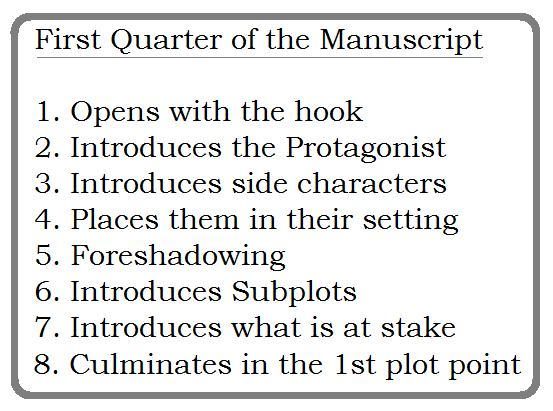
Elements of the Story 1st Quarter of the MSWhen I first began writing, I wasn’t concerned with the nuts-and-bolts aspects of a tale–I wrote stories to read to my children, and I wrote stories I wanted to read. The stories lived in my mind, and I got a great deal of pleasure from writing them. It never occurred to me to submit them to a publisher, and I wouldn’t have known how to do that anyway.

It wasn’t until my youngest child was in high-school that I began thinking about writing as a vocation, and began looking for places to submit my work. So my evolution as a writer was: I began by writing songs in high-school and also writing poetry, graduated to writing fairytales for my kids and short stories for myself, and finally began my serious attempt at a novel in 1996.

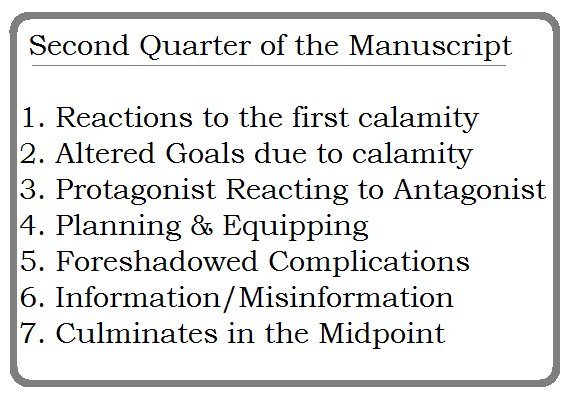
2nd quarter of the manuscriptI began writing for my own pleasure, and had no idea of how to plot a novel. Since that first attempt at a novel, I have completed six novels, and am working on 3 more at this time. Each book has been an improvement over the previous one. Through working with good editors and educating myself,  I feel like I finally understand how  a good novel is constructed.

In my early books, I didn’t understand the way a good story worked. I knew one when I read one, but I didn’t really understand what made that story immersive and memorable.

I had a grasp of how to create characters, and I had a good idea for the basic plot,  but I was weak in the area of structuring the novel. Once I realized that weakness, I set out to resolve it.

For the last two years, that has been the area I’ve worked hardest on putting into practice, and for those who have beta-read my yet to be published work, that change in my understanding of how to write a novel is clear.

Now, I have an instinctive understanding that the evolution of the story can be graphed out in an arc–the Story Arc. I had heard of this concept, and in writing groups some authors will talk about it as if they understand it, but when you read their work it’s clear they don’t.

It wasn’t until Scott Driscoll, author of Better You Go Home gave a seminar on it last year that the pieces fell into place for me.

The Story Arc copy

Some books are character-driven, others are event-driven. ALL of them follow an arc.  For my personal reading pleasure, I prefer Literary Fantasy, which has a character-driven plot. Events happen, often in a fantasy setting, but the growth of the characters is the central theme, and the events are just the means to enable that growth.

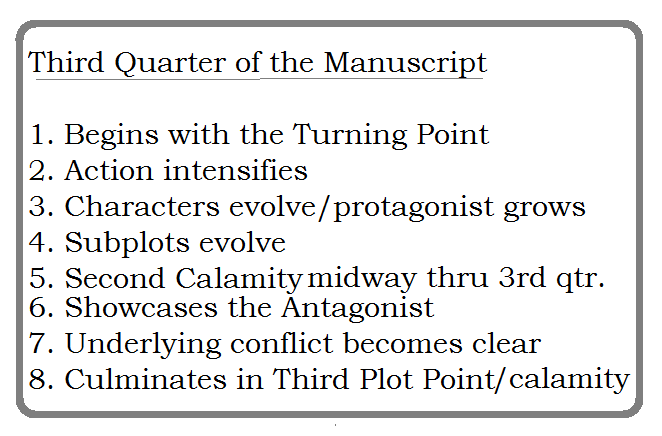
3rd qtr of manuscriptI write literary fantasy, with some emphasis on the fantasy. My own books, as in Huw the Bard, tend to be more character-driven than action oriented, as the Hero’s Journey is what intrigues me, but large events occur that cause personal growth. Whether your books are character- or event-driven, there must be an arc to the story.

We have talked about the way the manuscript can be divided into quarters.  Let’s consider the midpoint. The midpoint of the story arc begins the second half of the book. The first calamities have occurred and up to this point, the characters have been reacting to the antagonist’s moves.

The midpoint of the story arc is the Turning-Point, the place where there is no turning back. Consider J.R.R.Tolkien’s The Hobbit: At the midpoint, Bilbo is committed to seeing the Dwarves regain their home, and Smaug is routed, but at great cost. Now, he can see only disaster ahead of them, if Thorin continues down the moral path he has chosen.  Bilbo has been changing, but now he shows his true courage, by hiding the Arkenstone. Then he takes matters into his own hands in order to head off the impending war.  Bilbo tries to ransom the Arkenstone , but Thorin refuses to see reason. He banishes Bilbo, and battle is inevitable.

This arc is the same in every good, well-plotted novel: in the first half of the book everything had gone to hell, emotions were high, and the situation was sometimes chaotic, but the protagonist thought he had a grip on it. The Midpoint is the place where the already-high emotions really intensify, and the action does too. From this point on, the forces driving the plot are a train on a downhill run, picking up speed, and there is no stopping it or turning back now. The characters continue to be put to the test, and the subplots kick into gear.

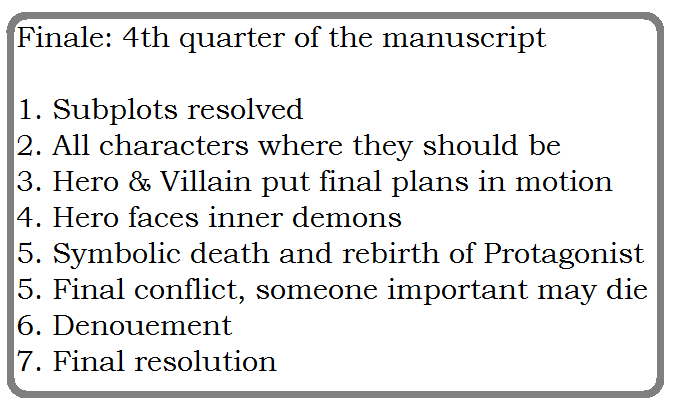
4th qtr of MSThe second half is where the villain shines–the evil one is on a roll and it’s his ballgame. The truth underlying the conflict now emerges, and it culminates in the third calamity, the third plot point. This is also where the villain’s weaknesses begin to emerge, and the hero must somehow exploit them.

The third quarter of the book, from the midpoint to the third plot point is critical. These events tear the hero down, break him emotionally and physically so that in the final fourth of the book he can be rebuilt, stronger, and ready to face the villain on equal terms.

The third quarter of the book frequently sets the hero on the path to enlightenment, but first he must undergo a symbolic death and rebirth.

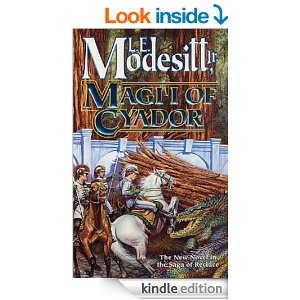
If you want to read classic fantasy where this type of story arc is really clear and yet the stories are strongly character driven, you should read:

magii of cyador


Magi’i of Cyador and Scion of Cyador by L. E. Modessit Jr. (2 books)


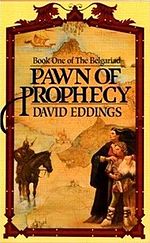
Pawn_of_Prophecy_cover


The Belgariad by David Eddings (5 book series)


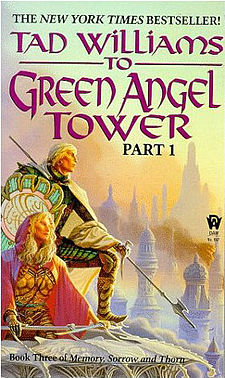
Green_Angel_Tower_P1


Memory, Sorrow, and Thorn by Tad Williams (4 paperbacks, 3 hard bound or ebooks)

6 Comments

Filed under Books, Fantasy, Literature, Publishing, Self Publishing, writer, writing

Structuring the Novel: the third plot-point, crisis of conscience

I don’t feel well. I have a mountain of work, and a spring virus has destroyed my very tight schedule.  I would bang my head if I didn’t already feel so crappy.

Today I have a client’s MS to begin editing.

Today I have revisions of my own to make on a ms I am getting ready to publish.

Today I was supposed to have a blog post ready to post on structuring the epic fantasy novel.

The Arc of the StoryWe were going to talk about the story arc, and how the third quarter of the book always begins with another life-changing plot-point. I was going to talk about how the the plot drives personal growth for the protagonist and his/her friends at this point.

And then I was going to discuss how this is the place where the protagonists often lose their faith or have a crisis of conscience. What personal revelations come out about the protagonist, or conversely what does he discover about himself?

I had intended to discuss how difficult this part of the novel often is to write, due to the fact that the protagonist has been put through a personal death of sorts–his world has been destroyed or shaken to the foundations and he no longer has faith in himself or the people he once looked up to.

  • How is he/she emotionally destroyed by the events?
  • How was her/his own personal weakness responsible for this turn of events?
  • How does this cause the protagonist to question everything she ever believed in?
  • What makes him pull himself together and just keep on going?
  • How is she different after this personal death and rebirth event?

quarrantine symbolI had intended to talk about that, but I don’t want to expose you to this crummy virus.  It always puts me through the emotional wringer to write this particular section of a tale, and I don’t feel well, so I can’t deal with talking about it. This low point is such a crucial part of the hero’s journey, the place during which he is taken down to his component parts emotionally, and rebuilds himself to be more than he ever believed he could be.

This is where she makes the hard decisions and learns that she truly does have the balls to do the job–

But I am too sick to talk about it.

I blame The Boy.  He was sniffling during his visit last week, and you know what a germ factory the average eight-year-old is.

4 Comments

Filed under Adventure, Books, Fantasy, Humor, Literature, Publishing, Self Publishing, Uncategorized, writer, writing

Elements of the story: calamity, villainy, and the hero’s struggle

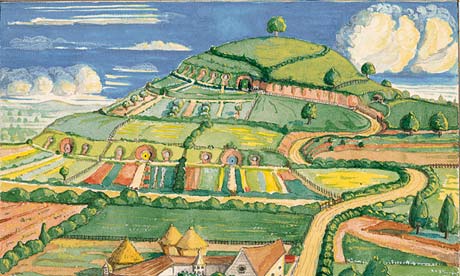
Tolkien's art work for Hobbiton-across-the-water

Hobbiton-across-the-water, by J.R.R. Tolkien

Most writing coaches agree that the first 1/4 of your story is where you reveal your characters and show their world while introducing hints of trouble and foreshadowing the first plot point. That is the first act, so to speak.

The Calamity:

Something large and dramatic must occur right around the 1/4 mark to force the hero into action, an intense, powerful scene that changes everything. Quite often, in epic fantasy the inciting scene will be comparatively disastrous, and one that that forces the protagonist to react. He/she may be thrust into a situation that radically changes their life and forces them to make a series of difficult decisions.

  • What incident or event will occur at the first plot point?
  • What negative effect does this event have for the protagonist and his/her cohorts?
  • How are hero’s efforts countered?
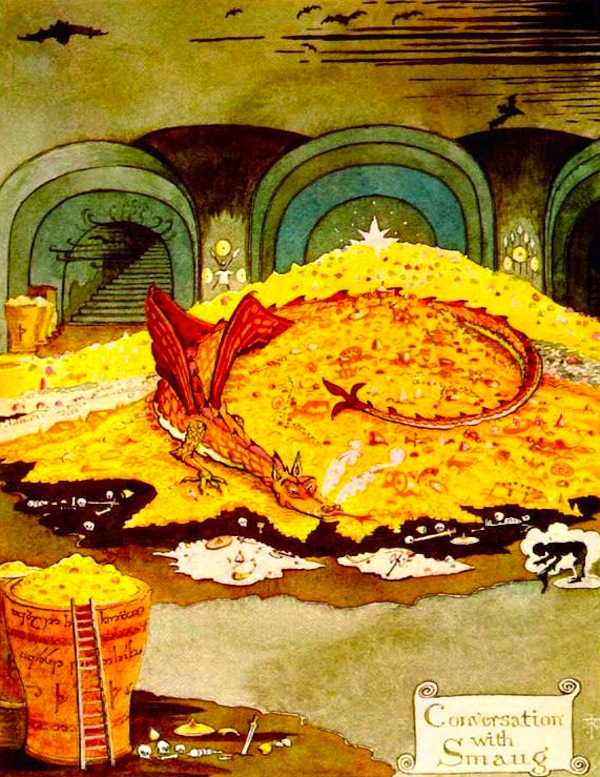
A conversation with Smaug by J.R.R. Tolkien

A conversation with Smaug by J.R.R. Tolkien

The Villain:

Conflict drives the story.  We know a great story has a compelling protagonist, but in order to have a great conflict, you must also have a great adversary. The hero has an objective, and so does the villain.

  • Identify the opponent–who is he/she, and what is their power-base?
  • What is the adversary’s primary goal, and who or what are they willing to sacrifice to achieve it?
  • Do the hero and the villain know each other, or are they faceless enemies to each other?
  • How does the adversary counter the hero’s efforts?

In fantasy, and often in thrillers and horror, we have an adversary who is capable of great evil. They may have supernatural powers, and at first they seem invincible. Their position of greater power forces the hero to become stronger, craftier, to develop ways to beat the adversary at his game. A strong, compelling villain creates interest and drives the conflict. Write several pages of back-story for your own use, to make sure your antagonist is as well-developed in your mind as your protagonist is, so that he/she radiates evil and power when you put them on the page. If you know your antagonist as well as you know the hero, the enemy will be believable when you write about their actions.

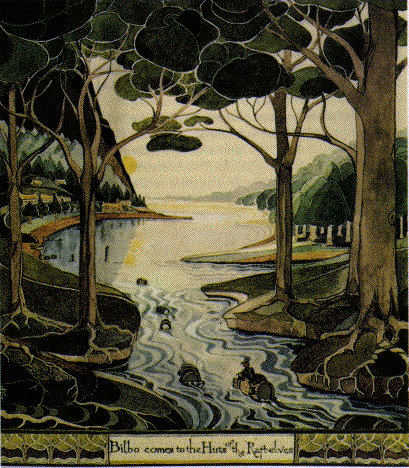
Bilbo comes to the huts of the raftelves by J.R.R. Tolkien

Bilbo comes to the huts of the Raft elves by J.R.R. Tolkien

The Hero’s Struggle:

Now the story is hurtling toward the midpoint, that place called the second plot-point. The characters are acting and reacting to events that are out of their control. Nothing is going right-the hero and his/her cohorts must scramble to stay alive, and now they are desperately searching for the right equipment or a crucial piece of information that will give them an edge. The struggle is the story, and at this point it looks like the hero may not get what they need in time.

Their weaknesses must be first exploited by the adversary, and then overcome and turned into strengths by the hero. The hero must grow.

During this part of the story you must build upon your characters’ strengths.  Identify the hero’s goals, and clarify why he/she must struggle to achieve them.

  • How does the hero react to being thwarted in his efforts during the second act to the midpoint?
  • How does the villain currently control the situation?
  • How does the hero react to pressure from the villain?
  • How does the struggle deepen the relationships between the hero and his cohorts/romantic interest?
  • What complications (for the hero) arise from a lack of information regarding the conflict, and how will he/she acquire that necessary information?
  • Midway between the first plot point and the second plot point, what new incident will occur to once again dramatically alter the hero’s path? This will be a turning point, drama and mayhem will ensue, perhaps offering the hero a slim chance. What stands in his/her way of realizing that small chance and what will the hero sacrifice to attain it?

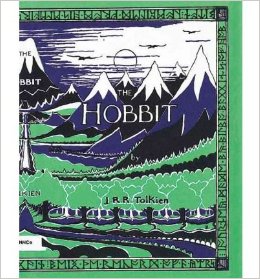
the hobbitThe first half of the book can be exciting or a bore–and because I’m always growing as an author, my new rule is “don’t write boring books.”

I say this because the books I loved to read the most were crafted in such a way that we got to know the characters, saw them in their environment, and bam! Calamity happened, thrusting them down the road to Naglimund or to the Misty Mountains.

Calamity combined with villainy creates struggle, which creates opportunity for great adventure, and that is what great fantasy is all about.

2 Comments

Filed under Adventure, Books, Fantasy, Humor, Literature, Publishing, Self Publishing, Uncategorized, writer, writing

Creating Conversations

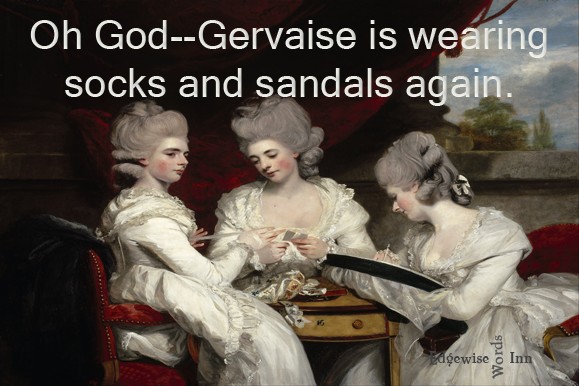
Socks and Sandals MemeConversations are easy to write…badly.

Unless the author thinks about it carefully, they can be stilted, stiff, and an unnatural wall of blah-blah-blah. Good writing involves learning the craft, and nowhere is that more apparent than in a conversation.

So how does the intrepid author write this phenomenon in such a way that it sounds natural? I always think of a conversation as having an arc: It begins, rises to a peak, and ebbs, an integral part of the scene, propelling the story forward to the next scene.

We might jabber about nothing, but in writing,  a good conversation is about something and builds toward something. J.R.R. Tolkien said that good dialogue must have a premise and moves toward a conclusion of some sort. If nothing comes of it, the dialogue is a waste of the reader’s time.

First, when we write about conversations between our characters, we want to ensure they don’t all sound like the same person. Imagine you are at a party. If you look around you, observing the conversations going on in small clusters, you will notice that every person has different mannerisms. The same is true of your characters when you see them in your head. With that image in mind,  you want to include those differences in their gestures, and their manner of speech.

When people talk, they rarely follow grammatical rules. Any English class you’ve taken will have stressed the importance of using proper grammar and punctuation in your writing, and believe me, those rules are important. However, when we attempt to write dialogue, those same rules should be thrown out of the window. People speak in broken sentences, with pauses, and even use incorrect words.

Now we get to the part where my editor and I have our own little conversation—the one where I stick random bits of punctuation in at odd places and she puts them where they belong or removes them entirely:

She: “I agree with the grammar part. I take exception to the punctuation. Punctuation rules MUST be followed especially in dialogue so that the reader reads the dialogue in the same manner the writer intended it to be read.”

Me: “Yes, ma’am.” (Muttering as I find ways to insert action where I want the pauses to go.)

Leonard_Nimoy_William_Shatner_Spock's_Brain_Star_Trek_1968We all take breaths at different places. Some people speak quickly and off the cuff, with short bursts. Others consider their words before they say them and speak more slowly. Every person in a given room speaks with their own unique style and pattern.

What are the roots of these patterns?  Speech habits are born in the environment the speaker grows up in, but they become identifiable mannerisms acquired throughout our lives.

Consider how the conversation fits into the arc of the scene.

We’ve talked about this before, but it bears repeating: first we must identify what must be conveyed in our conversation.

  1. Who needs to know what?
  2. Why must they know it?
  3. And how many paragraphs do you intend to devote to it?

My rule of thumb is, keep the conversations short and intersperse them with scenes of actions that advance the plot. Walls of meaningless conversation don’t keep the action moving and will lose readers, so  the conversations you include in your narrative must be important—and intriguing.

Author James Scott Bell says dialogue has five functions:

  1. To reveal story information
  2. To reveal character
  3. To set the tone
  4. To set the scene
  5. To reveal theme

SHotel California Memeome people will have the characters discuss the back-story, and this can be good if done the right way, in small snippets at critical points, and only when that information is needed. But this can be bad, especially when used as away to dump history in long, bloated paragraphs of dialogue.

Don’t give your characters long paragraphs with lines and lines and lines of uninterrupted dialogue. Those are sometimes seen as a wall of words by the reader. When asked how to write a good book, Elmore Leonard said, “Try to leave out the part that readers tend to skip.”

That goes double for dialogue. When I think of the novels I’ve enjoyed the most, the important information in their conversations is dealt with up front, and the minor details emerge later as they become important.

We don’t want our characters to be just a bunch of talking heads, sitting around, yammering on. It’s unnatural and doesn’t happen in real life except on the nightly news.

I’ve mentioned this before, but your characters should pause in their conversations, and sometimes miss a few beats. Beats are what screenwriters call the little bits of physical action that are inserted into dialogue and which in a novel can serve to indicate who said what without a dialogue tag interfering with it. Actions serve to punctuate the dialogue, to give the scene movement, and to maintain a strong mental picture, especially when an author is trying to balance the use of dialogue tags.

e3-2013-trailer-final-fantasy-x-x-2-hd-remasterRemember, actions are best placed where there’s a natural break in the dialogue. They show the mood and personality of your characters and allow the reader to experience the same pause in the dialogue as the characters do, and increase the sense of immediacy, making the scene real in the reader’s mind. It’s through the small habits we give our characters that we convey a little bit of their back-story, without having to resort to an info dump.


3 Comments

Filed under Books, Fantasy, Humor, Literature, Publishing, Self Publishing, Uncategorized, writer, writing

Serial commas

serial commas meme, martha stewartCommas: those little morsels of goodness that few authors understand. In general, serial commas are used to resolve ambiguity. When we have a list in a sentence, not using commas can create some interesting situations.

Comma use is part of what we call ‘style:’

  1. Google says: “Style is the way writing is dressed up (or down) to fit the specific context, purpose, or audience. Word choice, sentence fluency, and the writer’s voice — all contribute to the style of a piece of writing.” 
We use a style to ensure consistency in our phrasing and punctuation, and make it easier for the reader to enjoy the book. The books I use to help me with that are Elements of Style, the Chicago Manual of Style, and the Oxford A-Z of Grammar and Punctuation.   In my opinion, as an avid reader, the style that always uses the serial comma is less likely to result in ambiguity. Consider the legendary book dedication often attributed to Teresa Nielsen Hayden:

To my parents, Ayn Rand and God.

There is ambiguity about the writer’s parentage, because Ayn Rand and God can be read as meaning that the writer claims Ayn Rand and God are the parents. That is actually rather hilarious because Ayn Rand is famously atheist in her beliefs. (I’m not qualified to say whether or not God believes in Ayn Rand.)

Lets-eat-GrandmaHowever, a comma before and removes the ambiguity: To my parents, Ayn Rand, and God.

But lists can also be written in other ways that eliminate the ambiguity without introducing the serial comma, such as using other punctuation, or none, to introduce or delimit them. For example, in the following manner:

To God, Ayn Rand and my parents. Hemingway used and in place of commas in much of his work, and it was quite readable.

A famous example reportedly collected by Nielsen Hayden was found in a newspaper account of a documentary about Merle Haggard:

Among those interviewed were his two ex-wives, Kris Kristofferson and Robert Duvall.  This could be taken to mean that Kris Kristofferson and Robert Duvall were Merle Haggard’s ex-wives.

Although Merle Haggard has been married five time, he was never married to either Kris Kristofferson or Robert Duvall,  and a serial comma would resolve that inaccuracy:

Among those interviewed were his two ex-wives, Kris Kristofferson, and Robert Duvall.

chicago manual of styleI’ve seen people launch into rants  against serial commas, claiming that it’s too many and looks awful.

I’m just going to say that argument  is hogwash.

Who are your writing for, yourself or an unknown reader who may one day buy your book?

If you are writing for your own eyes only, do whatever you like.

But if you expect others to enjoy your work, you need to think about the reader: consider what is going to make your work easy for the reader to understand what you are saying.

Other aspects of commas may escape me at times, but the serial comma, also known as the Oxford comma, is one I adhere to in my own work, and heartily wish other authors would too.


4 Comments

Filed under Books, Fantasy, Humor, Literature, Publishing, Self Publishing, writer, writing

World building part 5: history

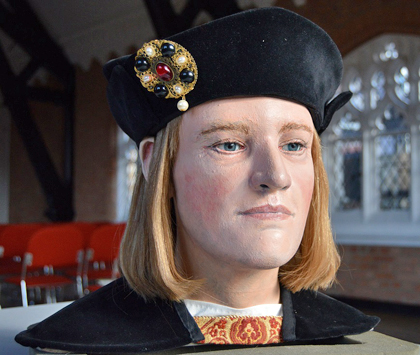
Richard IIISometimes we feel like our plot is in motion but the reasons driving the action feel purely random. It’s a worldbuilding failure, but an easy fix. In writing historical fiction, a sense of randomness can be a factor, despite having accounts of real events to go by. This is where research becomes critical, because those who win the wars write the history, and they write it to show themselves in the best light. Consider Richard III:
Richard’s history was written by the victors. He was the last Plantagenet King of England, and he was defeated at the Battle of Bosworth by the Henry Tudor. The Tudor dynasty lasted for a long time, including Henry VII, Henry VIII, (Bloody) Mary, and Elizabeth I. Consequently, he was mythologized as a tyrant, particularly by Shakespeare, writing during Elizabeth’s reign, two generations later.

Richard III new lookYet with uncovering of his bones in a parking lot, there is a growing evidence that the Richard III Society may not be entirely wrong: his story may have been a bit less damning, and certainly he was no worse than those who followed him. He was a man of his era, as much as Henry Tudor was.
That all-too-human tendency to cover up  our failures and atrocities in the light of our righteous victory over a declared evil introduces contradictions and ambiguities into official accounts of events. That makes the work of creating an accurate portrait of large-scale events difficult.

Looking backward from our viewpoint, and with our values, it’s hard to figure out how things really happened in a particular era, without going well beyond the general, official history offered up by the fount of all knowledge, Wikipedia, and doing sincere, dedicated research. It’s easy to say “this happened this way and that’s that.” (It’s repetitious, too.)

But there will be accounts somewhere, and if they exist you will find them on the internet. Wikipedia is the starting point. Search for accounts that disagree with accepted dogma, and keep rephrasing your questions until you hit on the right one. Bookmark or keep a list in a word document of links directing you to the sites you have found, even if they had little to offer–you might need them later.

Remember, if you’re drawing on real-life history you must dig deep–don’t just skim the surface, reading the official recounting of events as written by the victors.  The internet is amazing. Historians are continually building our database of information and new discoveries regarding how ordinary people and marginalized groups truly lived. Many resources exist that will give a rounded account of life in the Middle Ages both in Western Europe and in countries around the world.

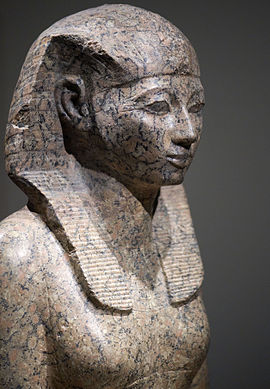
220px-HatshepsutIf you are relying on actual history to provide a framework for your world-building, you should reach beyond the official history of Europe. Asian history is rich and well documented, as is Egyptian. Of course the old adage that history is written by the victors holds true, as I said before, so let’s consider the story of Hatshepsut:

She was described by early Egyptologists as a minor player, only having served as a co-regent from approximately 1479 to 1458 BC, during years seven to twenty-one of the reign previously identified as that of Thutmose III. However, recent evidence shows that in reality, Hatshepsut reigned as pharaoh for more than twenty years.

Her successors, for whatever reason, attempted to rewrite history, erasing her name from monuments. Yet Hatshepsut was one of the most prolific builders in the ancient world, commissioning hundreds of construction projects throughout both Upper Egypt and Lower Egypt. Her buildings were considered far grander than those of any of her Middle Kingdom predecessors’ works, and were certainly more numerous.

Despite the long period of prosperity during her rule and the amazing constructs she built of stone, Hatshepsut’s influence and accomplishments were marginalized and credit for her work was given to others. Early Egyptologists superimposed their own ideas and values on their interpretations of history.

270px-WLANL_-_koopmanrob_-_Maat-ka-Re_Hatsjepsoet_(RMO_Leiden)They failed to understand the ritual religious symbolism of statues an art depicting her and didn’t take into account the fact that many women and goddesses portrayed in ancient Egyptian art often lack delineation of breasts, and that the physical aspect of the gender of pharaohs was never stressed in the art. This is in part due to the fact that in ancient Egyptian religious art, subjects were romanticized to fit the ideal of the time, and viewing it from an Edwardian mindset, early scholars believed her merely an overly ambitious “King’s Great Wife” or queen consort.  Recent discoveries, however, are righting that wrong, and she is now considered one of the greatest pharaohs of Egyptian history.

Nowadays, it may be easier to find good, unbiased information on ancient Egypt than it is to get an impartial history of post WWII America.

Reality aside, what if your story revolves around a conflict of some sort in your fictional world?

A major worldbuilding trap that is easy to fall into is not clarifying why an event of apocalyptic proportions is taking place at this moment in time, rather than, say thirty years ago.

So in our second draft, one thing we want to strengthen is our sense of history. WHY is Evil Badguy making his move now? What stopped him from putting his nefarious plan into motion two years ago, and conversely, why can’t he wait until next week? Some critical factor must have prevented him from making his move, some obstacle which no longer holds him in check.

What you have to do is identify what it was that  kept your villain in check, and make sure it is somehow introduced into the story. This can be done in the same unobtrusive way you slip in other background. In the process you will discover factors that kept other political actors in your society in check as well. It’s all about checks and balances. What are the unwritten rules that everyone knows and which constrain their actions?

The main difference between writing historical fiction and speculative fiction is that the writer of speculative fiction can make the history fit the tale. The writer of historical fiction does not have that latitude.


2 Comments

Filed under Books, Fantasy, History, Publishing, Self Publishing, writing

World Building part 4: Questions to consider when creating a society

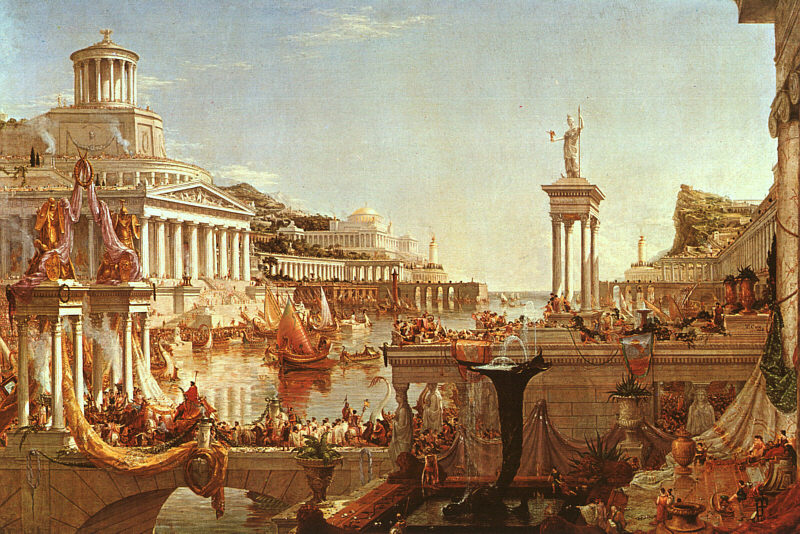
Thomas Cole, 1836: the Course of Empire: the Consummation

Thomas Cole, 1836: the Course of Empire: the Consummation

In speculative fiction, we often have one culture that is more advanced in contrast to the neighboring, somewhat more primitive cultures. Each of these societies have unique cultures, and if you know the culture of your characters’ homeland, you understand your characters and why they think the way they do.

But what is a society formed of? Initially, people come together and form  small communities, or tribes,  for protection. They find it’s a good way to consolidate more consistent sources of food and resources. With adequate food and shelter, people live longer and are generally healthier. Out of a need to get along with each other, they develop certain commonly agreed upon rules-of-the-road for sharing that wealth. Eventually these common rules become a complex social structure. As life becomes easier for the population in general, other amenities of civilization begin to be a part of their culture.

I write in many different worlds with widely varying levels of technology and forms of government. When I first began writing I knew it was important to know what the social structure was in each fantasy world, so I made a list of questions to consider when I begin constructing a new society. I was new at this, so please bear with the randomness of the order in which these things are listed:

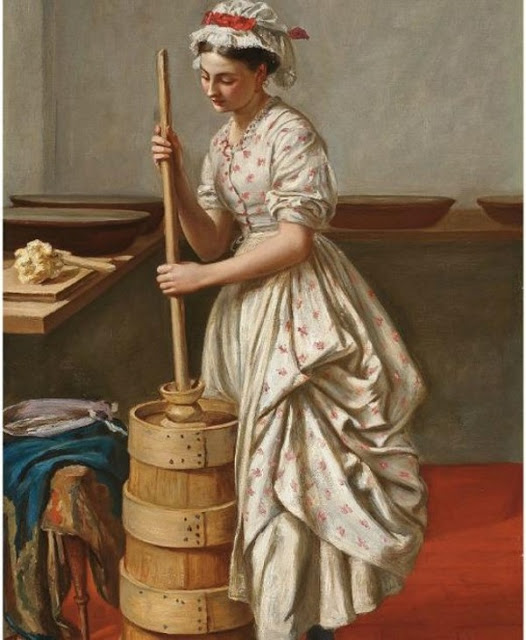
  1. The butter churnSocial Organization: Society is always composed of many layers and classes. How is your society divided? Who has the wealth? are there
  • Nobility?
  • A servant class?
  • A merchant class
  • A large middle class?
  • Who makes up the poorest class?
  • Who has the power, men, women—or is it a society based on mutual respect?
  1. Language, the written word, and accounting: Do they have a written language? This is really important if you are setting your people in a medieval world or in a really low-tech society, because it determines how knowledge is passed on. Low-tech generally equals an oral tradition.
  • How are people educated?
  • Who is allowed to learn to read and write?
  • How are bards, storytellers and other disseminators of knowledge looked upon?
  • How is monetary wealth calculated?
  • Do they use coins? What is their monetary system? If you are inventing it, keep it simple. (I generally use gold,  divided into tens: 10 coppers=a silver/ 10 silvers=a gold)
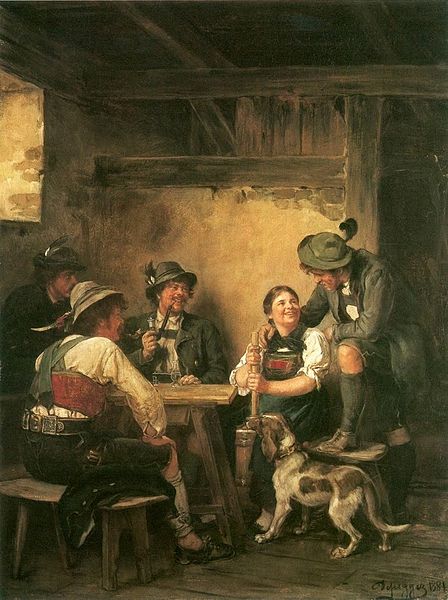
  1. Franz Defregger, 1921: Auf der Alm

    Franz Defregger, 1921: Auf der Alm

    Ethics and Values: What constitutes morality?

  • Is marriage required?
  • How are women treated? How are men treated?
  • How are same-sex relationships viewed?
  • How are unmarried sexual relationships seen in the eyes of society?
  • How important is human life? How is murder punished?
  • How are treachery, hypocrisy, envy, and avarice looked upon?
  • What about drunkenness?
  • How important is truth?
  • What constitutes immorality?
  • How important is it to be seen as honest and trustworthy?
  1. Religion and the Gods: How important is religion in this tale? If it is central, ask yourself: Is there one god/goddess or many? If the worship of a deity is a key part of your tale, you must design the entire theology. You must know the rituals, and know how their deity holds their hearts. You must know how that deity considers his/her worshipers.
  • What sort of political power does the priestly class wield?
  • What is the internal hierarchy of the priesthood?
  • Who has the power?
  • Is this religion a benevolent entity or all-powerful, demanding, harsh?
  • How does the priesthood interact with the community?
  • Who can join the priesthood
  • Do people want to join the priesthood or do they fear it?
  • How is the priesthood trained?
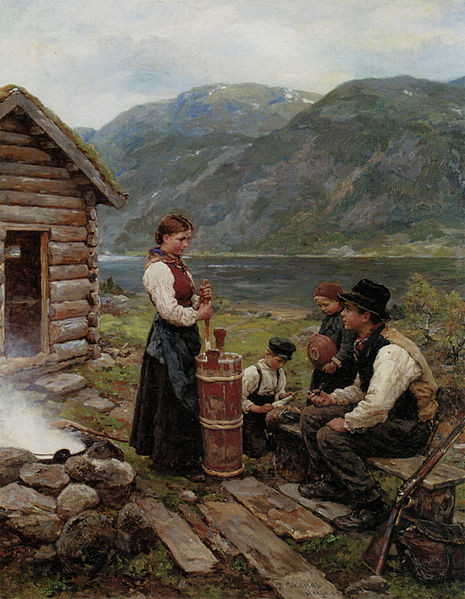
  1. Jahn Ekenæs, 1908: Family in a Norwegian fjord landscape

    Jahn Ekenæs, 1908: Family in a Norwegian fjord landscape

    Level of Technology: What tools and amenities does this society have available to them? What about transport?

  • Hunter/Gatherers?
  • Agrarian/farming
  • Greco-Roman  metallurgy and technology?
  • Medieval metallurgy and technology?
  • Pre-industrial revolution or late Victorian?
  • modern day?
  • Or do they have a magic-based technology?
  • How do we get around and how do we transport goods? On foot, by horse & wagon, by train, or by space shuttle?
  1. Government: There will be a government somewhere, even if it is just the local warlord. Someone is always in charge because it’s easier for the rest of us that way:
  • Is it a monarchy, theocracy, or a democratic form of government?
  • How does the government fund itself?
  • How are taxes levied?
  • Is it a feudal society?
  • Is is a clan-based society?
  • Warlord, President, or King/Queen?
  • How does the government use and share the available wealth?
  • How is the government viewed by the citizens?
  1. Crime and the Legal System: What constitutes criminal behavior and how are criminals treated?
  1. Foreign Relations: Does your country coexist well with its neighbors?
  • If not, why? What causes the tension?
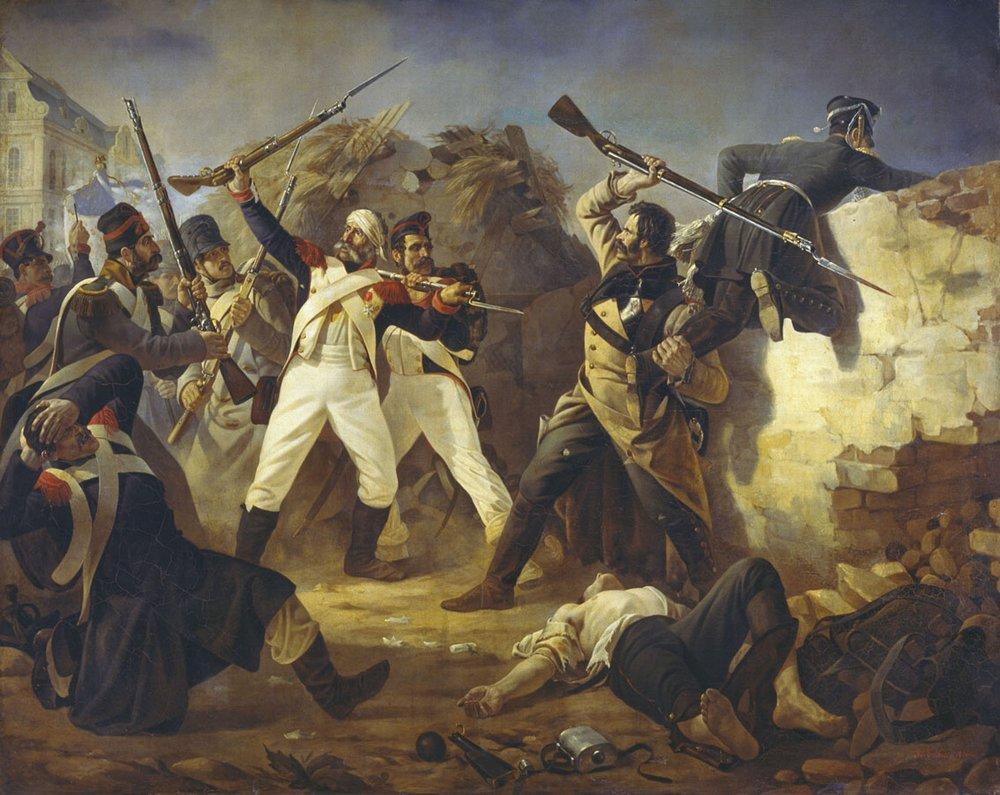
  1. Feat of the grenadier of leib-guards Finnish regiment Leontiy Korennoy in the battle of Leipzig at 1813

    Feat of the grenadier of leib-guards Finnish regiment Leontiy Korennoy in the battle of Leipzig at 1813

    Waging War: This is another area where we have to ask what  their level of technology is. It is critical for you as the author to understand what sort of weapons your characters will bring to the front, and also what the enemy will be packing. Do the research and choose weaponry that fits your established level of technology.

  • What kind of weaponry will they use?
  • How are they trained?
  • Who goes to battle? Men, women, or both?
  • How does social status affect your ability to gain rank in the military?

This is by no means a comprehensive list. It was initially meant to be a jumping off point, just a short list of things for me to ponder, but I thought I would share it with you today. Considering this little list of ideas always leads to my realizing a kajillion other rather large concepts that  combine to make up  a civilization. You are welcome to use this roster to form your own inventory of ideas about society.

What I originally did was to write the whole story of the community my protagonist grew up in, a word-picture of about 5000 words, and then I set it aside, to use as reference material. This is the method I still use today.

When you have cemented the society in your mind,  the world your characters inhabit will flow naturally and your protagonists will fit into it organically. Their society will be visually real to the reader, even if the world it evokes in their minds isn’t exactly your vision of it. You will have done your job, by giving them a solid framework to imagine the story around.

2 Comments

Filed under Books, Fantasy, Humor, Literature, Publishing, Self Publishing, Uncategorized, writer, writing